- 75% of total e-grocery orders are now served through quick commerce
- 20% of total online sales is from Quick commerce
- 26.2 million consumers used Quick-Commerce in India during 2024
- Valued at $3.34 billion, Q-Commerce is projected to rise to $9.95 billion by 2029
- 400,000 people presently employed in Q-Commerce – growing rapidly
Q-Commerce Is Booming… But What Does It Mean for SMEs?
If you’ve been watching how people shop these days, you’ve probably noticed this: a growing number of folks in cities aren’t stepping out for groceries or snacks anymore. They’re tapping a few buttons on their phones, and boom — the products arrive in just 10 minutes.
Welcome to the world of Q-commerce (quick commerce) — one of the fastest-growing sectors in India right now.
In just the past couple of years, platforms like Blinkit, Zepto, Instamart, and BigBasket Now have transformed the way urban India shops for daily needs. Whether it’s a packet of chips or detergent, customers now want it delivered yesterday.
According to Redseer Strategy Consultants, the Indian Q-commerce market was valued at $0.3 billion in 2021, but it’s expected to grow to a whopping $5 billion by 2025 — that’s a compound annual growth rate (CAGR) of 67%! And get this — it might even reach $20 billion by 2030.
So, what does this rapid growth mean for small and medium businesses?
Let’s break it down.
How Q-Commerce Is Disrupting Traditional Distribution in India
Until recently, if you were a small or mid-sized FMCG brand, entering retail meant going through a long chain of distributors, wholesalers, and retailers — all gatekeepers to the customer.
But now, large brands are increasingly bypassing these intermediaries by selling directly to customers via Q-commerce platforms.
According to a recent Times of India article, up to 35% of e-commerce revenue for major FMCG companies now comes from Q-commerce platforms. That’s huge.
Big brands like Hindustan Unilever, Nestlé, ITC, and Tata Consumer Products are leading this charge. They’re investing heavily in quick delivery partnerships because:
- It cuts down the supply chain.
- It boosts margins by avoiding commissions and distributor cuts.
- It appeals to younger, urban, high-income consumers who value speed and convenience.
But here’s the catch…
The Vacuum Left Behind by Big Brands
As large brands shift their focus to Q-commerce, something interesting is happening.
Distributors in India — who earlier made most of their income selling top-selling FMCG products — suddenly find themselves without their bestsellers. With high-margin brands moving to direct sales, distributors and even kirana retailers are seeing a drop in footfall and revenue.
This shift is creating a gap in the urban distribution market.
Retailers, desperate to keep their shelves stocked and sales steady, are more open than ever before to trying new brands.
And this is where you, the SME brand or startup, come in.
The Opportunity for SME Brands and Startups
For a long time, SME brands struggled to break into general trade because distributors were hesitant. Why?
Simple: distributors don’t like risk. They prefer fast-moving, well-known brands that sell quickly.
But now, with fewer big brands in the game and more shelf space up for grabs, even conservative distributors are being forced to look at new options. If you’re a small or medium business, this could be the best time to approach your local distributors.
Even better, your pricing may be more attractive than that of national brands — which helps both the retailer and the consumer.
What Makes This the Right Time to Act?
Let’s be honest — India’s FMCG and retail market is still massive. Despite Q-commerce’s rise, 70-75% of FMCG sales in India still come from general trade. That’s not going to change overnight.
But urban markets are in flux. While Q-commerce focuses only on a few high-demand PIN codes, the rest of urban India is waiting for fresh brands to step in.
So, if you’ve been trying to grow your distribution, this is the time to be proactive.
Distributors, wholesalers, and super stockists are more receptive now than they’ve ever been.
How Can SMEs Make the Most of This Q-Commerce Revolution?
Here are some practical steps to help you tap into this opportunity:
1. Reach Out to Distributors India-Wide (Start Local!)
Look around your own city or town. There are hundreds of distributors in India who are now actively searching for new, saleable products. Don’t wait for them to find you — take the first step.
Start with your local area. Meet distributors face-to-face with your product samples. Not only does this build trust, but even if they don’t place an order, you’ll get invaluable feedback.
2. Make Your Product Distribution-Ready
Before you approach a distributor, make sure your packaging, pricing, and logistics are well planned.
Questions to ask yourself:
- Is the packaging attractive and ready for retail display?
- Can your pricing compete with popular brands?
- Can you ensure timely delivery and restocking?
A well-prepared pitch will increase your chances of getting on-boarded.
3. Use Online B2B Platforms to Your Advantage
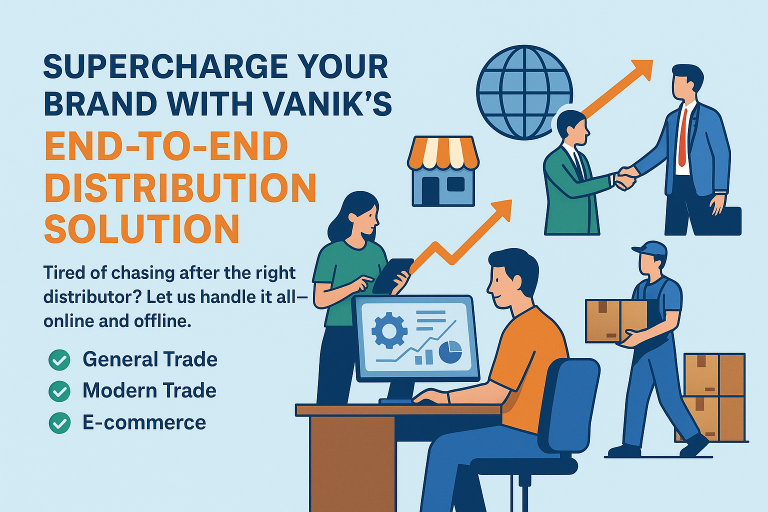
Websites like Vanik.com can help you identify the right channel partners — from distributors to wholesalers to C&F agents. You’ll find educational videos, negotiation tips, and even sample templates to guide your outreach.
One particularly helpful resource is the free video: “How to Start and Scale-Up B2B Distribution“ — a must-watch for any SME founder looking to grow.
4. Target the Right Product Categories
Remember, not every product sells well through Q-commerce. The top-performing categories are:
- Packaged food and snacks
- Beverages
- Personal care
- Home cleaning products
If you operate in any of these segments, you’re already positioned well. If not, think creatively: is there a way to tweak your product line to fit fast-moving categories?
5. Don’t Ignore General Trade
Even as you explore modern trade and Q-commerce options, general trade still forms the backbone of FMCG sales in India.
Try hybrid models — some brands are building presence via distributors and using Q-commerce only for last-mile delivery in key PIN codes. The point is to be visible where your consumer is looking.
Limitations of Q-Commerce (And Why They Help You!)
Let’s not forget — Q-commerce, for all its hype, has some major limitations:
- It’s still concentrated in top 20–30 cities.
- It caters mostly to upper-income, digital-savvy customers.
- It relies heavily on only a few categories.
- High operating costs and tight margins have already caused one major player (Dunzo) to scale down operations in early 2024.
This means there’s still space for traditional distribution models to thrive, especially if you can offer value pricing and smart packaging.
Final Word: Distributors in India Are Evolving — Are You?
The Indian distribution market is undergoing a silent transformation. With the rapid rise of Q-commerce, the traditional food chain is being reorganized.
And while that might spell trouble for some players, it spells opportunity for smart, nimble SME brands.
Whether you’re a D2C brand testing waters offline, or a family-run SME trying to scale, now is the time to talk to distributors, wholesalers, and super stockists in India. They’re more open than ever.
So pack those samples, polish that pitch, and get out there. The shelves are empty, and your product might just be what fills them.
Need Help Getting Started?
Looking for a curated list of trusted distributors in India, wholesalers, or even export agents? Head to Vanik.com — a platform designed specifically for SMEs and startups.
You’ll find:
- Verified distributor lists across every state and city
- Negotiation tips and pitch guides
- Educational blogs and videos to master distribution strategy
Got questions? Reach out. We’re here to help you grow.